

The Birth of a Coal Island: Gunkanjima (Hashima Island)
Gunkanjima, also known as Hashima Island, was once the most densely populated place on earth and a symbol of Japan’s rapid industrialization driven by coal mining. Today, as a UNESCO World Heritage Site, it stands as a haunting reminder of human resilience, community, and the passage of time.
HISTORY OF NAGASAKI
11/3/20253 min read
The Birth of a Coal Island: Gunkanjima (Hashima Island)
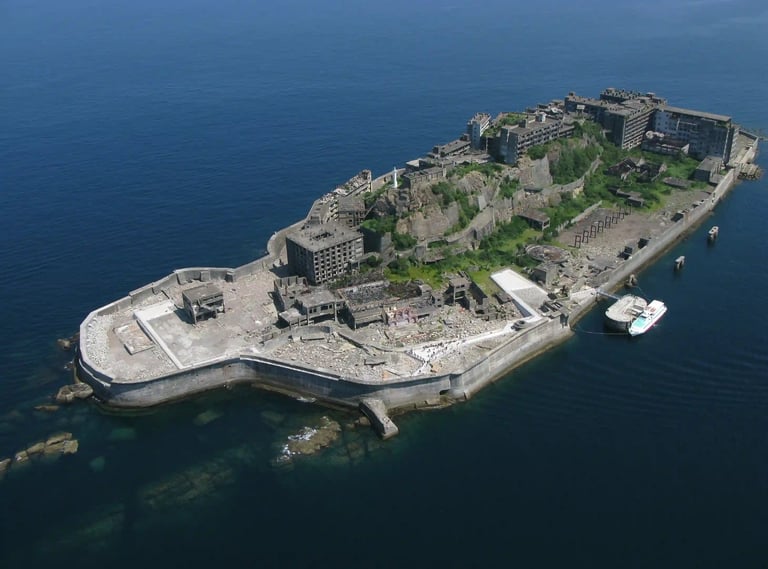
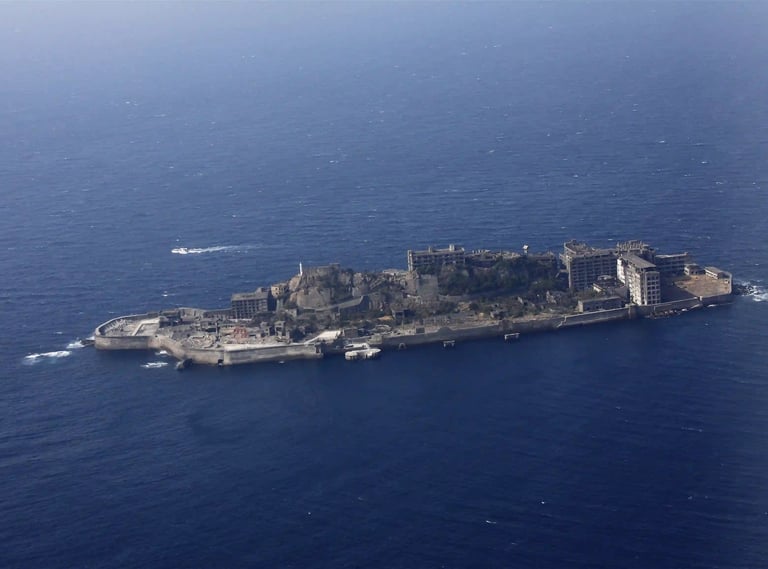
Gunkanjima, officially known as Hashima Island, is a small island located about 18 kilometers southwest of Nagasaki City. Before industrial development, the island was nothing more than a rocky outcrop with a circumference of just 1.2 kilometers.
Everything changed during the Meiji era when coal was discovered beneath the seabed. In 1890, Mitsubishi purchased the island and began full-scale coal mining operations. As mining expanded, land reclamation projects were carried out to create space for housing and industrial facilities.
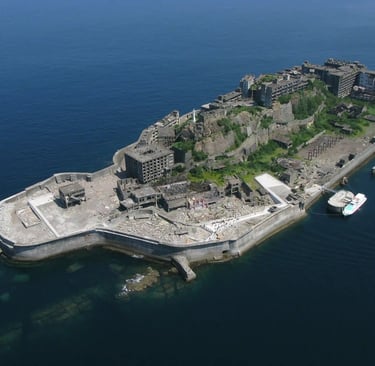
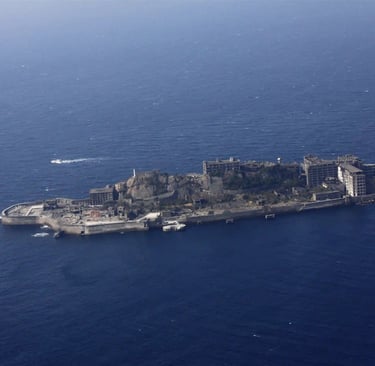
Over time, the island’s silhouette came to resemble a battleship floating on the sea, earning it the nickname “Gunkanjima,” meaning “Battleship Island.”
The World’s Most Densely Populated Island
At its peak in the 1960s, approximately 5,300 people lived on this tiny 6.3-hectare island. This made Gunkanjima one of the most densely populated places in the world, with a population density about nine times higher than Tokyo at the time.
Despite its small size, the island functioned as a complete city. It had schools, a hospital, a shrine, a movie theater, barber shops, and even a pachinko parlor. In 1916, Japan’s first reinforced concrete apartment building was constructed on the island, marking a major milestone in Japanese architectural history.
Daily Life on Gunkanjima
Life on Gunkanjima was intense but deeply communal. With such limited space, residents relied heavily on one another, forming strong bonds and a shared sense of responsibility.
Former residents often recall how strong winds would blow laundry away, yet no one worried if clothes got mixed up, as everyone knew each other. Children played baseball on rooftops, and if a ball fell into the sea, they would jump in to retrieve it. Although mining work was physically demanding and dangerous, daily life on the island was filled with energy, laughter, and resilience.
Abandonment: The Island Where Time Stopped
In 1974, during Japan’s energy transition from coal to oil, the Hashima coal mine was closed. On a single day, all residents left the island, and Gunkanjima became completely uninhabited.
Personal belongings such as furniture, pianos, school textbooks, and calendars were left behind. Over time, wind, rain, and waves battered the concrete structures, creating an eerie atmosphere as if time itself had stopped. For more than 40 years, public access to the island was prohibited due to safety concerns.
UNESCO World Heritage Status and Modern Rediscovery
In 2015, Gunkanjima was registered as part of the “Sites of Japan’s Meiji Industrial Revolution” on the UNESCO World Heritage list. Today, it is recognized as a powerful symbol of Japan’s rapid industrialization and the human cost behind it.
Landing tours now allow visitors to walk among the remains of apartment blocks and mining facilities. Many describe the experience as “stepping into a movie set.” The island’s haunting appearance has even inspired filmmakers, most notably appearing as visual inspiration in the James Bond film Skyfall.
Lesser-Known Stories from the Island
There were almost no locks on doors, as theft was virtually unheard of.
Residents created rooftop gardens by carrying soil upstairs to grow vegetables.
The island remained brightly lit at night due to 24-hour mining operations and neon signs, giving it the feel of a living city even after sunset.
Conclusion: More Than Just Ruins
Gunkanjima is more than an abandoned island. It is a place where thousands of people once lived, worked, raised families, and shared dreams. It represents both the pride of Japan’s industrial rise and the fragile, fleeting nature of progress.
Many visitors say that even in the silence, they can still feel the presence of those who once called the island home. That lingering human warmth, preserved within the crumbling concrete, is what continues to draw people to Gunkanjima today.
Explore Gunkanjima with a Local Perspective
If you would like to explore Gunkanjima and other historical sites in Nagasaki with a knowledgeable local guide, Nagasaki Private Tours offers private, in-depth tours tailored to your interests.
Learn more here:
https://nagasakiprivatetours.com